Harvest Notes
I first wrote this blog post on October 9th, and I wrote that the “…season has been warm and dry, with most of the temperatures in the 70’s and 80’s, and even up into the 90’s in October. This has made for a rather leisurely harvest experience, allowing us to schedule every fruit lot near its peak ripeness, without any worry about disease pressure, or impending weather phenomena.” Southern Oregon vintages, however, tend to have a flair for the dramatic, and two nights of frost, (on October 11th and 12th) have brought this vintage to an abrupt end.
A frost on October 12th, while not totally unusual, would typically be more impactful. In most years, we might still have a lot of fruit still on the vine. Frosts burn a vine’s leaves, and while the fruit itself is not harmed, it means that ripening is over. However, conditions this year have meant that everything was already ripe before the frost occurred. Sunday morning’s frost brings a dramatic end to the 2026 harvest, but not a tragic one.
The main criticism of the 2026 harvest is that there’s not very much of it. Spring frost significantly reduced yields in many area vineyards, with some crops down by almost 50%. The frost hit early varieties like Chardonnay, Pinot Noir and Tempranillo particularly hard. Later varieties like Grenache, Syrah, Cabernet Franc and Mourvèdre did comparatively well. Fortunately, our own Estate vineyard had a very good year, and the majority of our wines for Quady North will be made from our Estate this year, including our Rosé.
In many years, I’ve had to reach out to my vineyard consultant to help me understand problems and issues in our vineyard. This year, I reached out to try and figure out why we were so successful. It seems that we can credit a few good decisions and a little bit of luck.
In the winter of 2022, I reached out to my vineyard consultant, Dr. Paul Skinner. We had a string of poor yielding harvests from the Mae’s Vineyard and we also needed to replant the Eevee’s Vineyard, which we had removed because it was infected with the Red Blotch Virus. I asked him for recommendations, both to amend the soil before replanting Eevee’s, and for help in addressing issues we were seeing in Mae’s Vineyard. In addition to low yields, our grape must “YAN’s” (Yeast Assimable Nitrogen levels) were very low. Yeast need nitrogen to make cell walls and replicate. If there is insufficient nitrogen in the grape juice, the yeast will use sulfur containing compounds instead. When this happens, eggy off-aromas occur. We can add nitrogen to our juices, and we do if naturally occuring YAN is insufficient, but many studies have shown that naturally occuring nitrogen makes for better aromas and healthier fermentations. I was hoping that Dr. Skinner could help me both increase yields and YAN’s.
At Eevee’s, we added compost and Dolomite, a form of Calcium which also includes Zinc and Magnesium. Soil tests at Mae’s revealed that it also needed soil amendments, as well as Nitrogen. We had amended the soil at planting, but over time, those amendments had been used up or had eroded away, and the likely cause of the poor yields was nutrient deficiency. Interestingly, the vines seemed healthy. Leaves were green and canopies were full. However, the low YAN’s, poor fruit set and small clusters were all signs that our grapevines needed more nitrogen, as well as calcium to help them pick up the nitrogen that was in the soil.
In 2023 we added amendments to both Mae’s and Eevee’s vineyards and replanted the Eevee’s vineyard. We also sewed cover crops and added compost. Dr. Skinner followed up with additional recommendations for nutrients to add through our drip system. One issue that I had been fighting for years was fruit set in our Grenache at Mae’s. Each year, inevitably, a lot of the Grenache berries would not mature past the initial green berry stage, resulting in light, loose clusters with a lot of small, hard green berries. According to Dr. Skinner, the issue was Zinc. Our soils were naturally deficient in Zinc, and this micronutrient was needed by grapevines in the berry development process. We added Zinc to our sprays just after bloom time, and also did some deep watering to make sure that the Grenache was not under stress during that time.
Each year, from 2023 through 2025, yields at Mae’s vineyard improved. Grenache clusters were noticeably fuller by 2024, and by 2025, cluster weights had increased by 50%. In the Cabernet Franc, where our yields had decreased from 10 tons in 2014 to only 4 tons in 2022, our harvest increased to 8 tons in 2024 and 11 tons in 2025. Meanwhile, the newly replanted Eevee’s vineyard grew fabulously. Normally, you don’t expect a harvest from a newly planted vineyard until the third year, but we had a small harvest in the second year, and a very nice crop in the third.
The most interesting observation in this process was how a relatively small addition of minerals and nutrients had a big effect. We used primarily organic formulations and added only a few pounds of Nitrogen per acre each year. The biggest impact probably came from adding calcium and raising our soil pH. Vines need calcium to pick up nutrients already in the soil. Additionally, acidic soils make it difficult for naturally occuring soil microbes to thrive, which are critical in breaking down organic matter to free up nutrients.
Healthier vines meant that our vineyard was better set up to resist the impacts of frost. However, we still would have seen a lot of damage if it wasn’t for a couple other tricks. Last winter was warm and very dry. I was pretty sure we would see an early budbreak, and, if buds came out early, that meant that frost risk would be higher. I decided to wait until very late to prune our vineyard. This delayed bud break by several weeks, since the vine had to work harder to try and push all the buds left over from last year, instead of just a few dozen typically left after pruning. When we did prune, in early April, I asked the crew to leave four canes on each vine, instead of the usual two. We tied two down and left the other two sticking up. After the frost on April 15th that damaged a lot of vineyards, we too saw a loss of up to 50% of our new shoots in some parts of the vineyard. However, by leaving two extra canes, we had twice as many buds as we usually did. So, even though we lost half, we ended up with a normal amount of buds. After the frost season, the crew tied down the extra canes, leaving each vine with four canes instead of two. We removed all the shoots that didn’t have fruit, and kept the ones that did, leaving us with a normal amount of fruit bearing shoots.
This morning we picked our last lot of Grenache for Rosé from Mae’s Vineyard and I tasted through the various press cycles. The press operates by increasing pressure in stages, from .4 to 1.7 bar. We taste each stage and decide whether or not we want to keep that stage, or end the press cycle. Higher pressures can result in lower acid juice and bitter, vegetal flavors. Often we discard the juice after 1.3 bar. Today, I kept all the press cycles. Each was delicious, with the higher pressures giving some spicy notes, but without any hard, soapy flavors.
Other standouts from this vintage include Cabernet Franc, which, in the fermenter, has that signature spicy red pepper note that I love. Tannat, a late ripener, often the last fruit to be picked, is happily combined with some Malbec and Viognier and tasting delicious. It’s a great year for Mourvèdre too, which can often be tricky to get fully ripe. We crushed Mourvèdre on Wednesday from the Ponderosa Estate vineyard, a small planting above Gold Hill. In the fermenter, it’s already giving that signature slightly gamey quality that we only get in the warmest years.
It’s very early, but this year has all the makings of a classic vintage, perhaps even more so because the yields are so small. Look for some big, rich red wines, and juicy, aromatic whites. I’m looking forward to seeing the last lots come in over the next two weeks, hopefully just before some huge rainstorm, so the vines, as well as the vineyard and winery workers, can get some much-needed rest, satisfied with the knowledge that we’ve all done our job in 2026, and done it well.
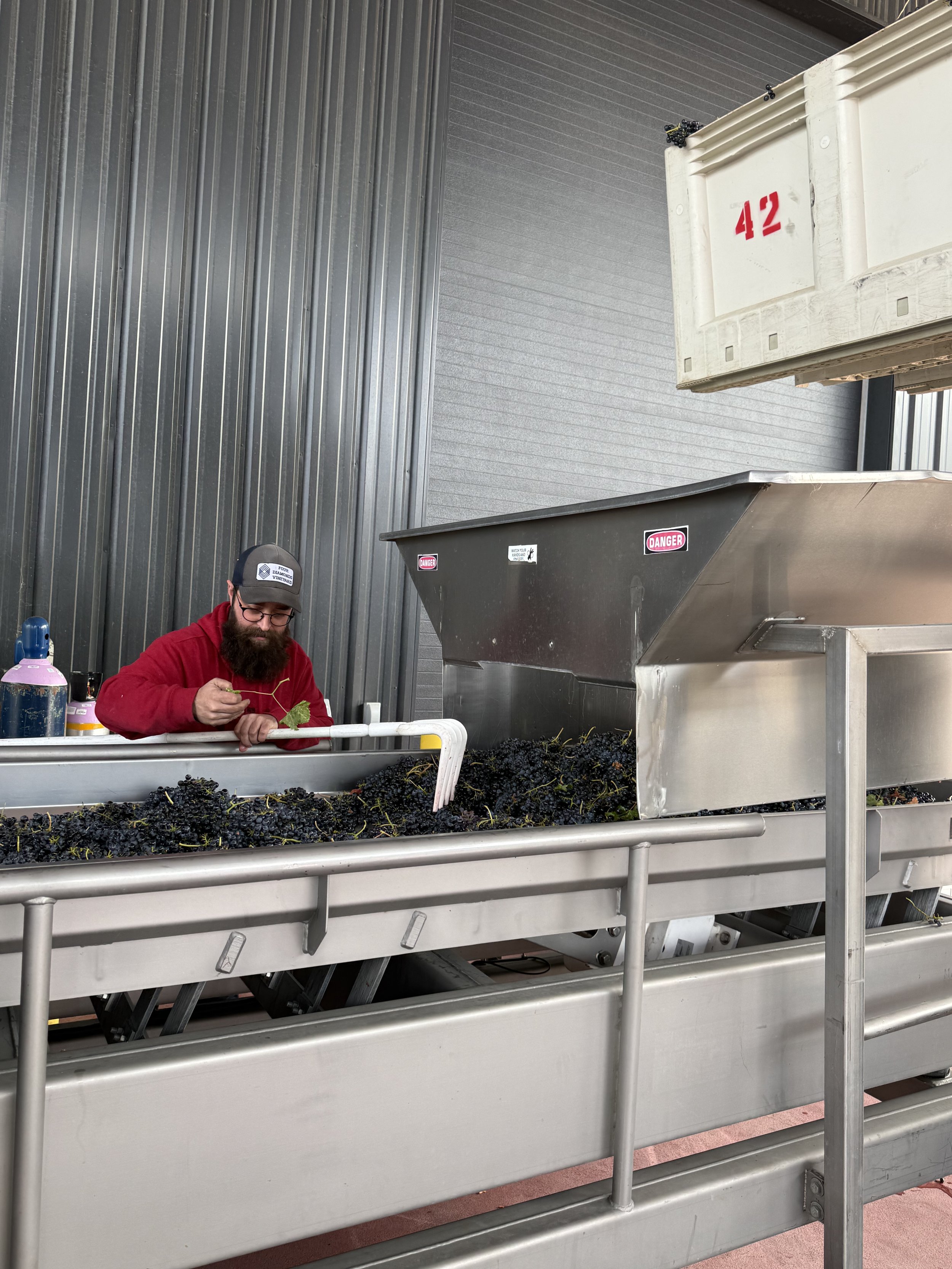
Mike Cress sorts Syrah from the Mae’s Vineyard